How to write a letter to a friend

Knowing how to write a letter to a friend mostly means sounding like yourself on paper. Here are six steps, from the first line to the sign-off, and four example letters to borrow from. You do not need good handwriting, only a reason and one true detail.

An example to start from

To Maya, after five years of silence

Dear Maya,

It's March 3rd, and I just found the photo of us on the pier in my coat pocket. We're both wearing those awful hats. I laughed out loud in the laundry room.

I'm sorry we went quiet. I don't have a good reason. Things got busy, then it felt awkward to write, then it was five years.

I would love to hear how you are. No pressure to answer fast.

Ellie
An example to borrow from. Make it yours.
How your letter stays yours

Private by default. Only the person you address can open it.
Delete any time: before it's opened, after, or everything.
Nothing is public unless you ask, and a person reads it first.
How privacy works
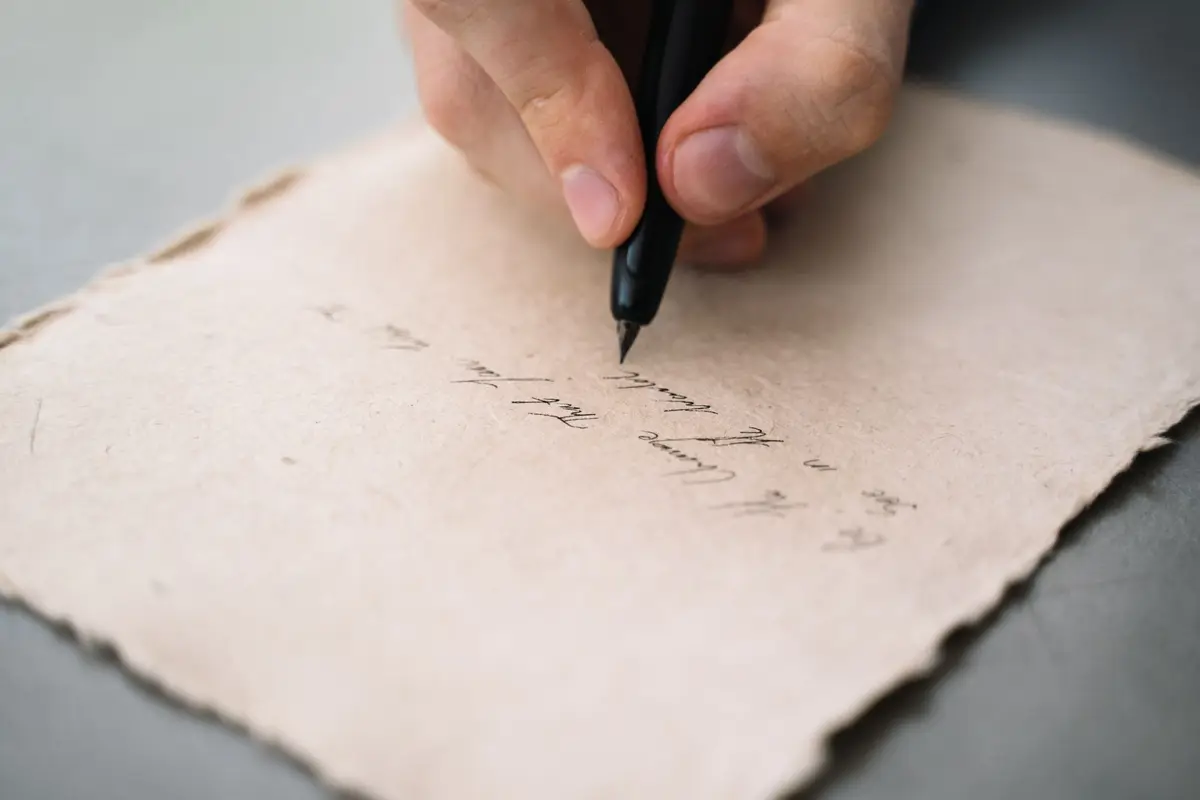
A hand writing a letter in ink on deckle-edged paper
Photo: Anna Tarazevich on Pexels

1. Put the date at the top and start the way you talk

Write the date in the top corner. It sounds fussy, but a dated letter is the one a friend finds in a drawer years later and can place exactly. Then greet them the way you would in person: "Dear Maya," for most letters, "Hey Maya," if that is how you two are.

Skip "I hope this letter finds you well" unless that is truly how you talk. Open with their name, and let the first sentence be something you would say out loud.

Letters to borrow from

We wrote these to show what a letter like this can sound like. Borrow a line, then make it yours: the small, true details are what make it land.

To Theo, who lost his job

Theo, you do not have to write back. I just want you to know I'm thinking about you.

I'm not going to say it will all work out, because I don't know that and you would roll your eyes. What I do know is that you fixed my car in a parking lot in the rain and never once made me feel stupid.

Saturday I'm bringing food. Don't cook. If you want to talk, we'll talk. If you want bad TV, we'll do that.

Ben
An example to borrow from. Make it yours.

A thank-you to Priyanka

Dear Priyanka,

Thank you for the month on your couch. You said it was no trouble, and I know it was, because I saw you move your whole schedule around my interviews.

I got the job. I'm writing to say I noticed all of it: the key under the mat, the extra pillow, you pretending not to hear me pacing at 2 a.m.

Dinner is on me, whenever you're free.

Josh
An example to borrow from. Make it yours.

A funny birthday letter to Carl

Carl, you are thirty-nine today, which means you are officially too old for that jacket and I am officially too late to tell you.

We have been friends since the fourth-grade science fair, where you glued your volcano to the table and I let you take the blame. I have never apologized. I'm not starting now.

Dinner Friday. I'll bring the cake you like, the dry one.

P.S. I'm only a month behind you. Don't think I didn't notice.

Dev
An example to borrow from. Make it yours.

2. Say why you are writing

Give the reason in the first two or three sentences. You miss them, you heard their news, you found an old photo, you have been meaning to say thank you. A reason saves them from wondering whether something is wrong.

If you do not have a big reason, a small one is fine: "I was thinking about you at the bus stop and decided to write." That is how most good letters to the friend who moved away begin.

3. Say one specific thing

The middle is where the letter lives. Skip big statements like "you mean so much to me" and say what sits underneath them: the time they drove forty minutes to help you move, the voice they do when they read a menu. One detail does more than a page of adjectives.

Then tell them a little about your own days, such as what you ate this week, what is happening at work, one new thing. It lets them see your life from where they stand. If they are going through something hard, say you are thinking of them and do not try to fix it. "No need to reply" takes the pressure off.

4. Ask something, and leave room for them

Near the end of the middle, ask a question they can answer in a sentence or a page. What was the best thing that happened this month? Do they still go to that diner? Easy questions get answered. Big ones such as "how are you really?" can feel like homework unless you are close enough to ask.

If the letter does not need an answer, say so. Writing for friendship should feel like a gift, not a debt.

5. Close with warmth, not a summary

The last paragraph should feel like walking them to the door. Say what you hope for them, or when you hope to see them. Do not repeat the whole letter.

Make a promise you can keep. "I will call on Sunday" is better than "we should catch up soon," which both of you will forget by Monday.

6. Sign off, add a P.S., and send it

Match the sign-off to the friendship:

  • Love, for close friends and family-like friends.
  • Always, or Yours, for old friends with history.
  • Take care, or Talk soon, for a lighter touch.
  • Your friend, when you want it plain.

Sign with the name they call you. A P.S. is the place for the funny thing or the thing you forgot. Read the letter once out loud and fix anything that sounds like someone else.

Then send it: a stamp and an address, or a wax seal for a flourish. You can also write an Open When letter for a friend, such as "Open when you need a laugh." It is free, there is no account, and it stays locked until the date you pick.

Questions that help you start

  • When did you last laugh with this friend, and what was it about?
  • What is one thing they said years ago that you still remember?
  • What do you wish you had thanked them for?
  • What is happening in your life that they do not know yet?
  • What do you miss about the way things used to be?
  • What small thing would make their week better?
  • What would you say if you knew they could not reply?
  • What is a place or a smell that brings them back to you?

Open When never writes your letter for you. These are only here to get the first line down.

Questions people ask

How long should a letter to a friend be?
One page is plenty, front and back at most. A short letter with one real detail is warmer than a long one written out of duty. If you have a lot to say, let it run longer and keep paragraphs short. Write until you have said the true thing, then stop and add a line about when you will talk next.
How do I write a letter to the friend who moved away?
Start with what you miss in daily life: the walk you used to take, the bench, the joke. Add one small update on your life and one question about theirs. Leave out guilt about how long it has been. A simple "I thought of you today" is enough to restart a friendship, and it is easy for them to answer.
How do I write a letter for friendship when I am bad with words?
Write as you would text on a good day, only a little longer. Use specifics: a place, a nickname, a thing they once said. Then read it out loud and change whatever sounds stiff. Plain words with one true detail beat polished sentences. Nobody expects you to write like an author, only like yourself.
Should a letter to a friend be handwritten?
Handwriting shows effort, but a typed letter with a handwritten sign-off is still a letter, and it is better than an unwritten one. If your handwriting is hard to read, type the body and sign by hand. What counts is the detail, not the pen.
Can I write a friend a letter they open later?
Yes. An Open When letter such as "Open when you need a laugh" stays locked until the date you pick, then waits for your friend to choose the moment. You choose the date it unlocks, and it cannot be opened before then. It is free and needs no account, and your friend can send one tap back, such as "Made me laugh" or "Thank you."

More letters like this

A letter lasts longer than a text: write one to a friend today.

Write a letter to a friend